

K-4 Missile vs JL-2 Missile: Comparing India’s and China’s Sea-Based Nuclear Standoff
India’s K-4 missile Vs. China’s JL-2 missile: The evolution of submarine-launched ballistic missiles (SLBMs) has reshaped strategic deterrence in Asia. Among the most significant systems in the region are India’s K-4 missile and China’s JL-2 missile, both designed to ensure survivable second-strike capability from beneath the seas. While they serve similar strategic purposes, their design philosophies, ranges, and operational roles differ markedly.
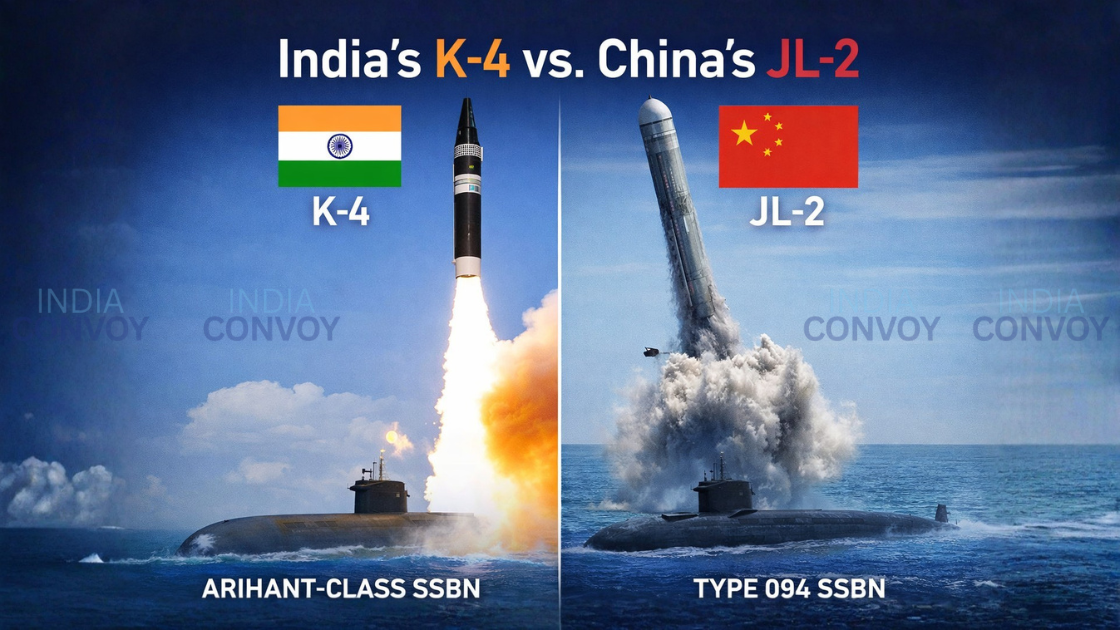
India’s K-4 vs Chinese JL-2
| Aspect | K-4 (India) | JL-2 (China) |
|---|---|---|
| Role | Regional strategic deterrent | Intercontinental deterrent |
| Range | ~3,000–4,000 km | ~7,200 km |
| Warhead | Single nuclear warhead | Single or multiple warheads |
| Launch Platform | Arihant-class SSBN | Type 094 SSBN |
| Strategic Focus | Survivable second strike | Long-range sea-based power projection |
Strategic Context
Sea-based nuclear forces are considered the most survivable leg of a nuclear triad. Submarines operating in deep waters provide assured retaliation even if land-based forces are neutralised. Both India and China have invested heavily in SLBMs to strengthen this dimension of deterrence.
The K-4 Missile represents India’s steady and indigenous approach to building a credible regional deterrent, whereas the JL-2 Missile reflects China’s ambition for a broader, intercontinental sea-based strike capability.
Design and Technical Profile
The India’s K-4 missile is a compact, solid-fuel, submarine-launched ballistic missile developed specifically for India’s Arihant-class nuclear submarines. It is approximately 12 metres long and weighs around 17 tons. Its 2.5-stage propulsion system enables a range of roughly 3,000 to 4,000 kilometres, depending on payload configuration.
In contrast, China’s JL-2 missile is a larger and heavier missile. Measuring around 13 metres and weighing over 40 tons, it uses a three-stage solid-fuel propulsion system. The missile’s most defining feature is its intercontinental-class range of about 7,200 kilometres, placing it in a higher strategic category.
Payload and Warhead Capability
India’s K-4 is believed to carry a single nuclear warhead, optimised for strategic deterrence rather than saturation or multiple target engagement. There is no confirmed public indication that it currently carries multiple independently targetable re-entry vehicles (MIRVs).
The Chinese JL-2, however, is designed with greater payload flexibility. It can reportedly carry either a single high-yield warhead or multiple MIRVs, allowing one missile to engage several targets. This capability significantly enhances China’s deterrence posture by increasing strike options from a limited number of submarines.
Accuracy and Guidance
The K-4 employs an advanced inertial navigation system supplemented by satellite navigation, providing high accuracy for a strategic missile. This reflects India’s emphasis on precision and reliability within its deterrence framework.
The JL-2 uses astro-inertial guidance supported by satellite updates. While its accuracy is reportedly lower than shorter-range systems, this is typical of long-range strategic missiles and is sufficient for nuclear deterrence roles, especially given its higher yield and MIRV potential.
Submarine Platforms and Deployment
The K-4 is deployed aboard Arihant-class SSBNs, which form the backbone of India’s sea-based nuclear deterrent. India’s approach focuses on maintaining secure patrol areas in the Indian Ocean, ensuring survivability rather than global reach.
China’s JL-2 is deployed on Type 094 Jin-class nuclear submarines, each capable of carrying multiple missiles. With a larger fleet of SSBNs and longer missile ranges, China can patrol farther from its coastline while maintaining coverage of distant strategic targets.
Operational Philosophy
India’s K-4 aligns closely with its minimum credible deterrence and no-first-use doctrine. The missile is designed primarily for assured retaliation, reinforcing stability through survivable second-strike capability.
China’s JL-2 reflects a more expansive deterrence posture. Its longer range and payload options allow for greater strategic flexibility and power projection, strengthening China’s overall nuclear posture at the global level.
Conclusion
India’s K-4 missile and China’s JL-2 missile reflect distinct nuclear deterrence strategies. The K-4 strengthens India’s credible second-strike capability through accuracy, survivability, and regional focus, aligning with its doctrine of minimum deterrence. The JL-2, with greater range and payload flexibility, supports China’s broader strategic reach and power projection. Together, they highlight the rising importance of sea-based nuclear forces in shaping stability and balance across the Indo-Pacific.