
Flexrotor: Nightwatch for the “Three Ds”
The Airbus UAS currently serves as a tireless eye in the sky, supporting firefighting missions at night for Precision
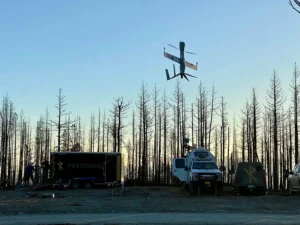
Oregon-based operator, Precision, was an early adopter of the Flexrotor drone, deploying the platform as far back as 2014. While CEO David Rath envisions a future of seamless teaming with crewed assets, the aircraft currently serves as a tireless eye in the sky – taking over the ‘Dull, Dirty, and Dangerous’ missions after dark while the majority of the company’s fire suppression crew take their well-earned rest.
Precision Helicopters utilises H215 Super Pumas and H125s for the most vital firefighting missions, and the workload is intensifying. “The firefighting industry has grown immensely over the last 15 years,” explains Rath. “Contracts that used to be 30 days are now four or five months. With fire danger increasing, this is becoming a year-round mission in the US.” To meet this demand, Precision has integrated the Flexrotor — a vertical take off and landing (VTOL) uncrewed aerial system (UAS) — into a high-stakes federal contract. As one of only two companies active in the Department of Interior’s long-duration, on-call aerial mapping contract, Precision now looks to a future where it may start to offer dedicated 90- to 120-day availability — a shift from the older ‘call when needed’ model that often left assets sidelined during critical windows of time.
Precision mapping in the blind
Wildfires move with devestating unpredictability. Matt Parker, President of Precision’s Uncrewed Business, is convinced the Flexrotor offers the right blend of durability to supplement crewed aircraft. “This technology has provided realtime intelligence for our military overseas for decades; it is time we offer those same capabilities to our firefighters.” The mission profile typically sees the Flexrotor launch in the evening to fly the fire’s perimeter. Working alongside a government geospatial specialist, the team uses video feeds with GPS references to track how acreage is growing and identify ‘high-value targets’ – such as critical infrastructure — that ground teams can then move to protect.

‘Post-containment’ audit
The most technical challenge isn’t finding the main fire — satellites can see the smoke — but identifying the hidden ‘hot spots’ left behind. “Those hot spots are what firefighters must attack to ensure they don’t develop into another large fire,” Parker notes. These infrared audits are a vital safeguard against the kind of catastrophic re-ignitions seen in the California Carr Fire, where incomplete ‘mopping up’ led to disaster even after 100% containment was declared. By guiding ground teams via radio to these invisible embers, the Flexrotor ensures a fire is truly out.

Teaming: the future
While modern aviation rules are still evolving to keep pace with the rapid nature of fire response, Rath believes the industry’s effectiveness depends on crewed-uncrewed teaming. By working in concert with partners to commit assets and share the operational burden, companies can better navigate the high costs and technical hurdles of early-stage UAS deployment. Precision is already looking toward ‘Initial Attack’ missions where this teaming becomes a tactical reality. In this scenario, a Flexrotor would be deployed alongside a Super Puma responding to lightning strikes to proactively find small embers before they become large fires. “The goal is a seamless digital handover,” says Rath. “We foresee a scenario where the Flexrotor lasers a hot spot with an infrared beam for a pilot with night vision goggles, or even transmits a direct GPS coordinate to an H215, which then automatically flies to the location for a precision water drop. That level of teaming is the only way to meet the mission going forward.” Fires keep burning after the sun goes down; but as the crews rest, the Flexrotor maintains its watch, ready to pass the torch to the crewed assets at dawn.