
Adani Defence & Aerospace and Leonardo Forge Strategic Partnership to Build India’s Helicopter Ecosystem
- Adani Defence & Aerospace and Leonardo announce a strategic partnership to develop, manufacture, and sustain a helicopter manufacturing ecosystem in India.
- The programme will address the increasing demand and new military requirements, positioning India as a future hub for helicopter manufacturing.
- The partnership paves the path for a new Indian helicopter ecosystem with the potential to be extended to the civil domestic demand, with dedicated localized industrial activities, and support the international supply chain.
New Delhi, 03 February. Adani Defence & Aerospace, the flagship defence and aerospace arm of Adani Enterprises Ltd and a frontrunner in India’s defence sector, today announced the signing of a Memorandum of Understanding (MoU) with Leonardo, the global leader in defence, aerospace, and security. This landmark partnership will establish a fully integrated helicopter manufacturing ecosystem in India, addressing surging military demands and propelling the nation toward self-reliance in helicopter production.
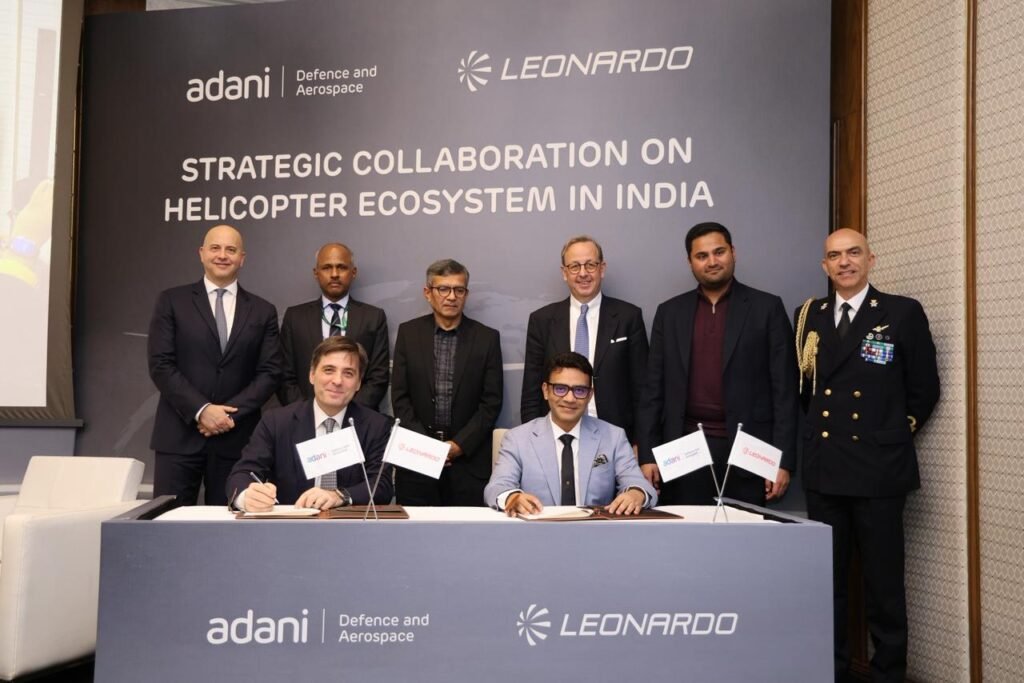
Targeting the Indian Armed Forces’ requirements, particularly for Leonardo’s advanced AW169M and AW109 TrekkerM helicopters, the collaboration will deliver phased indigenization, robust maintenance, repair, and overhaul (MRO) capabilities, and comprehensive pilot training.
By fusing Leonardo’s world-class helicopter design and engineering prowess with Adani Defence’s end-to-end defence and aerospace expertise, the initiative advances the Aatmanirbhar Bharat vision, strengthens national defence readiness, with the potential to be extended to civil aviation applications and international supply chain integration.
This ecosystem promises transformative economic impact: thousands of high-skill jobs in engineering, manufacturing, logistics, and sustainment services, while cementing India as a competitive hub for helicopter production.
Jeet Adani, Director, Adani Defence & Aerospace, stated: “This alliance with Leonardo is a pivotal stride toward a resilient, future-proof helicopter ecosystem in India. Merging global excellence with our industrial momentum, we will drive enduring value, high-skill employment, and alignment with Aatmanirbhar Bharat to position India as a global aerospace powerhouse.”
Ashish Rajvanshi, CEO, Adani Defence & Aerospace, added: “With the Indian Armed Forces projecting demand for over 1000 helicopters in the coming decade, this partnership realizes our vision for sovereign manufacturing. It will accelerate indigenization, strengthen supply chains, and establish India as a world-class production base.”
Gian Piero Cutillo, Managing Director, Leonardo Helicopters, affirmed: “We’re extremely pleased to join forces with Adani to provide our contribution to India’s vision for an even stronger and growing role of their rotorcraft industry, and to enable the country to access the level of modern technology and operational capability it deserves. We look forward to making progress in this endeavour, leveraging our complementary expertise to deliver the best solutions.”
This strategic partnership redefines India’s aerospace landscape, strengthening defence autonomy and position the country as a trusted global hub for helicopter manufacturing and sustainment.